Solution Whitepaper | Amsterdam Technologies
LeadGen: 6 Specialized AI Agents Discover, Verify, Score, and Contact Prospects Across 10+ Platforms
Existing data providers fail because they rely on static, rapidly decaying repositories. A contact list purchased today contains stale employment data, defunct…
The Problem
Modern business-to-business (B2B) revenue generation is constrained by a fragmented, highly manual prospecting lifecycle. Sales and growth teams are forced to operate across a disjointed stack of static databases, scraping utilities, email verification tools, and generic sequencing platforms. This structural gap creates massive inefficiencies: highly compensated sales representatives spend the majority of their time building lists, cross-referencing contact data, and drafting initial outreach rather than engaging in high-value qualification and negotiation.
Existing data providers fail because they rely on static, rapidly decaying repositories. A contact list purchased today contains stale employment data, defunct email addresses, and generic firmographics. Furthermore, legacy automation tools execute rigid email sequences without context, treating outreach as a volume game rather than a targeted engagement. This spray-and-pray approach leads to low conversion rates, burned domains, and damaged brand reputation. Organizations need a paradigm shift: from querying static databases to deploying dynamic, reasoning engines capable of autonomous discovery, corroboration, and contextual engagement.
Solution Overview
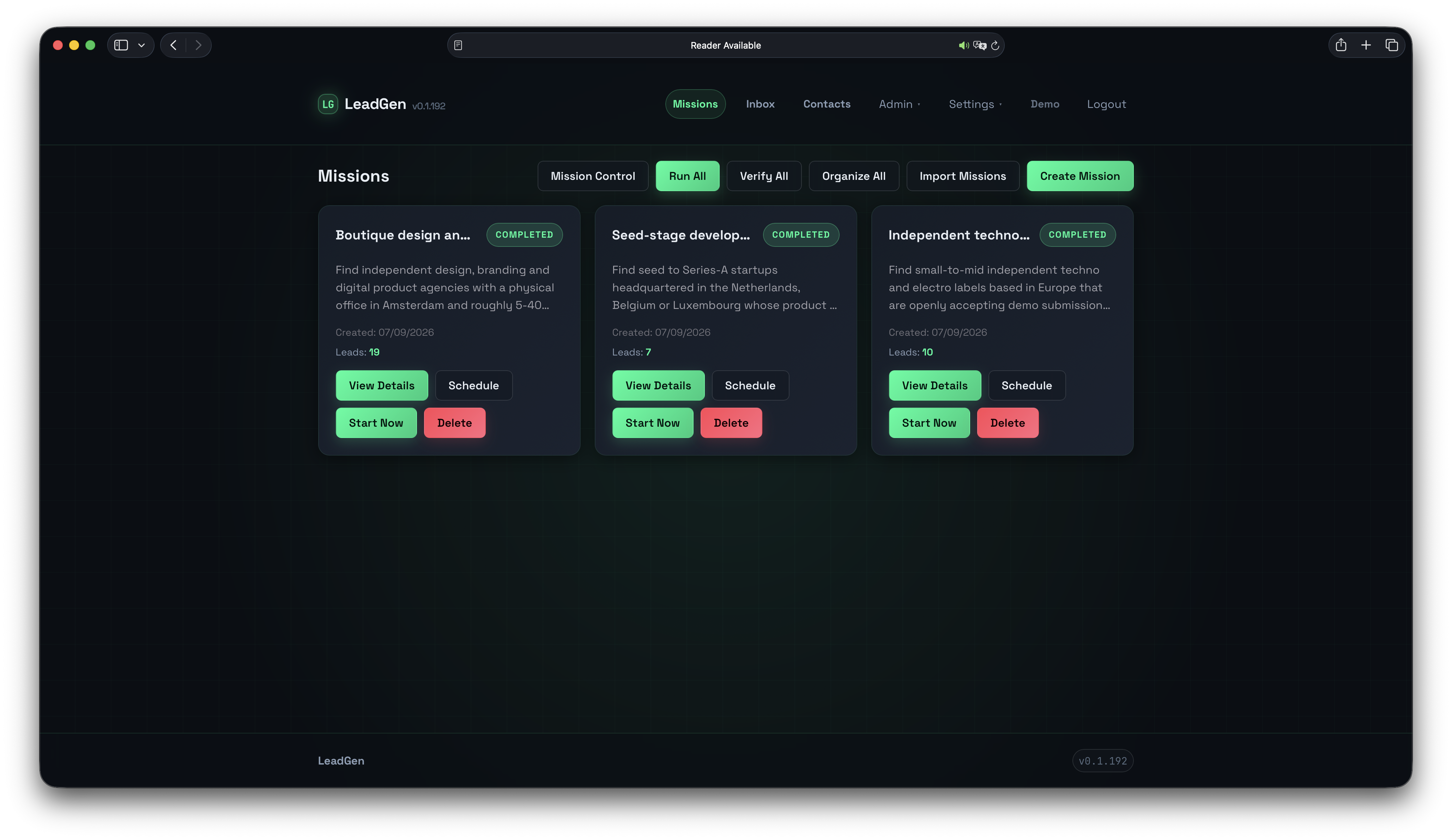
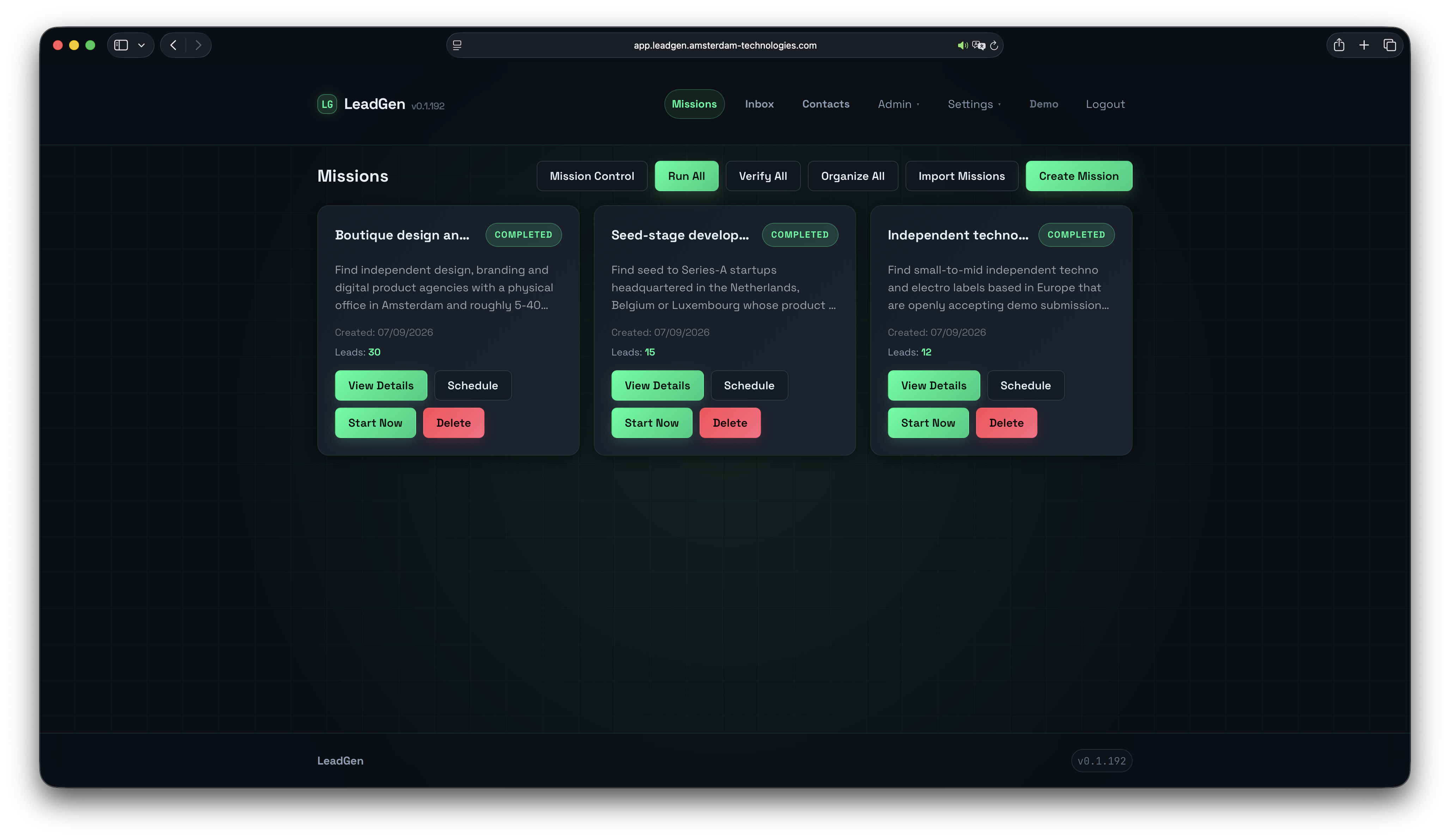
LeadGen is a production-ready, hosted Software-as-a-Service (SaaS) platform that replaces the fragmented prospecting stack with an autonomous, multi-agent artificial intelligence pipeline. Built on the Google Agent Development Kit (ADK) and powered by Google Gemini models, LeadGen executes the complete top-of-funnel lifecycle.
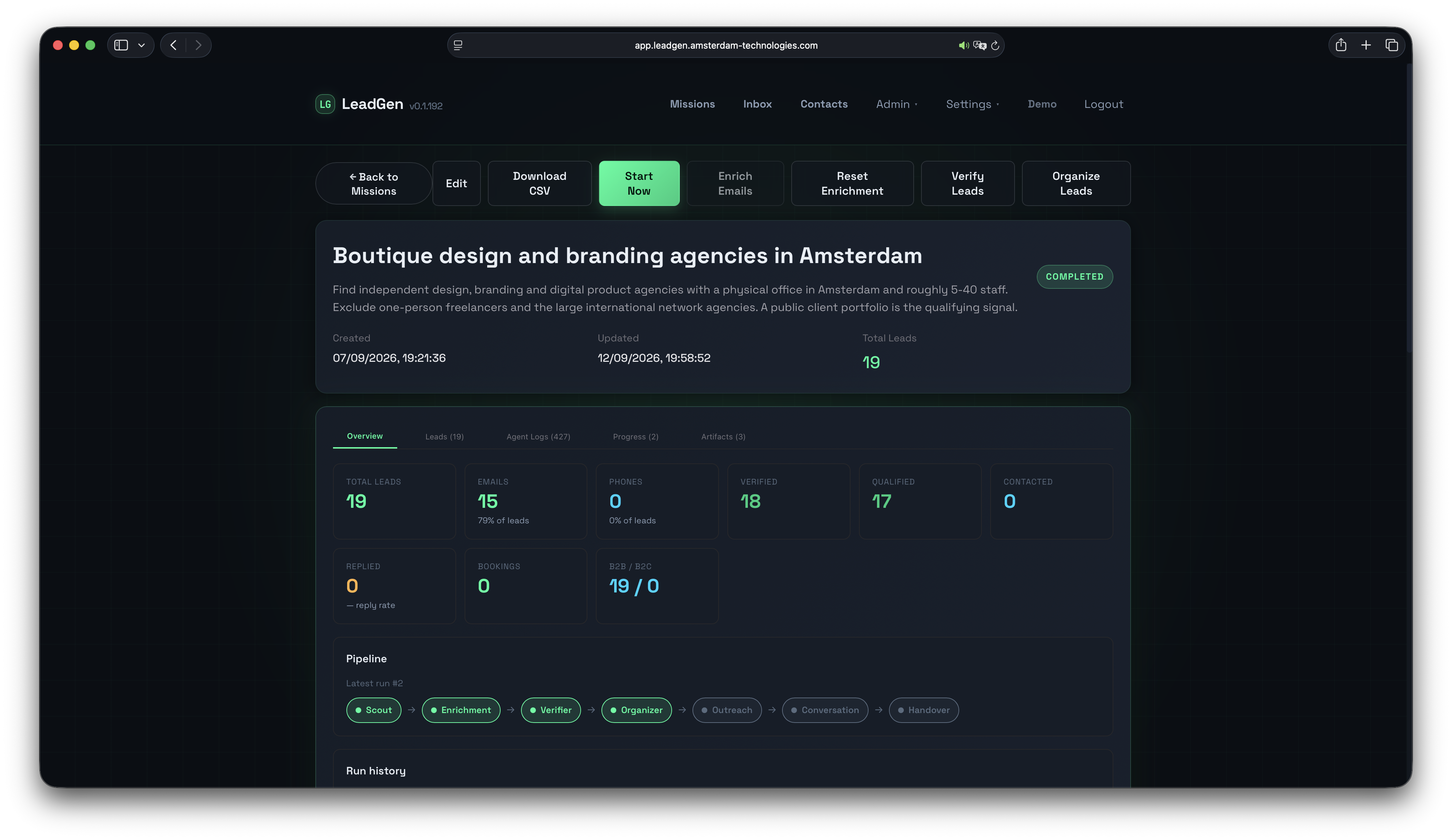
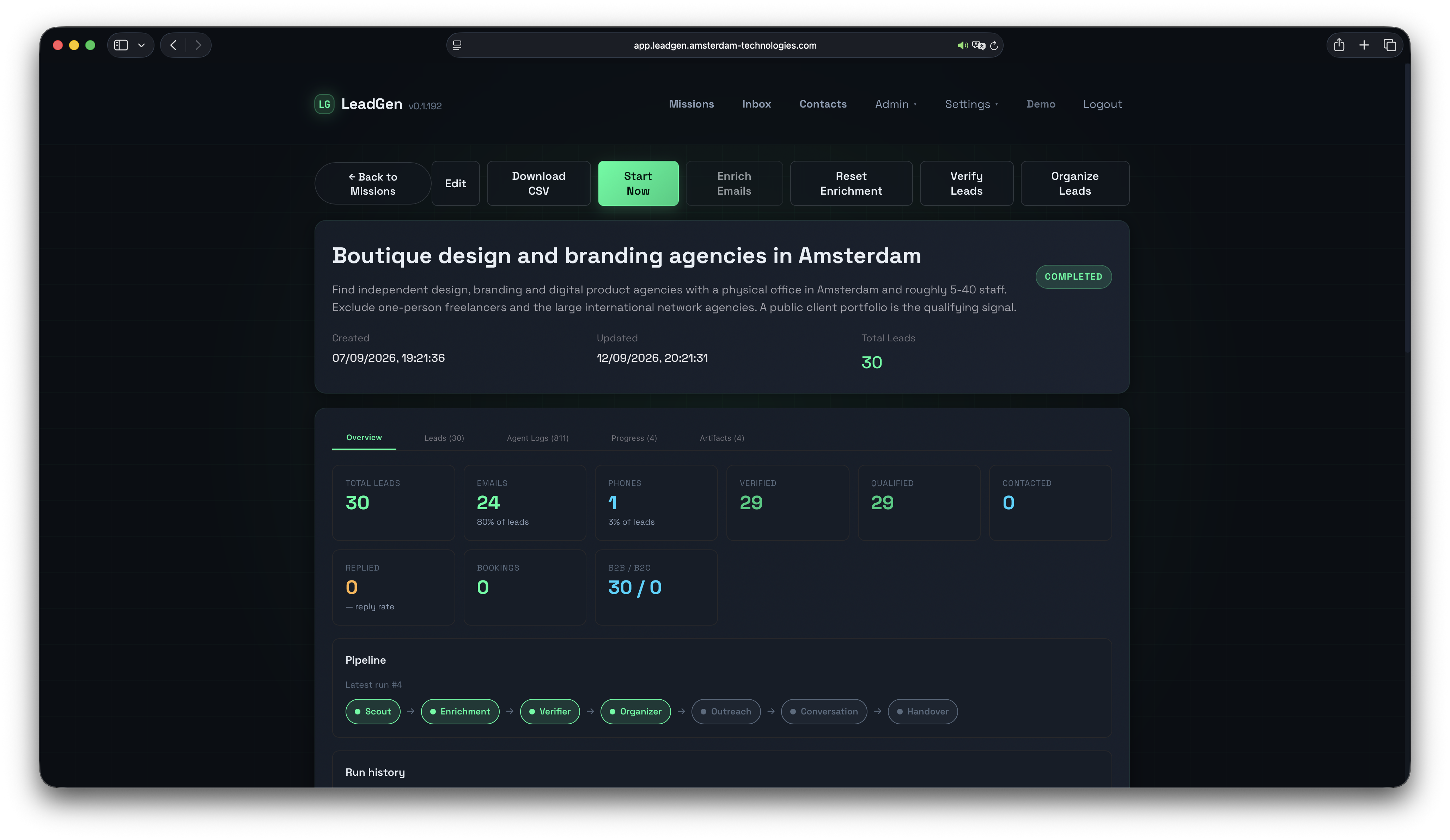
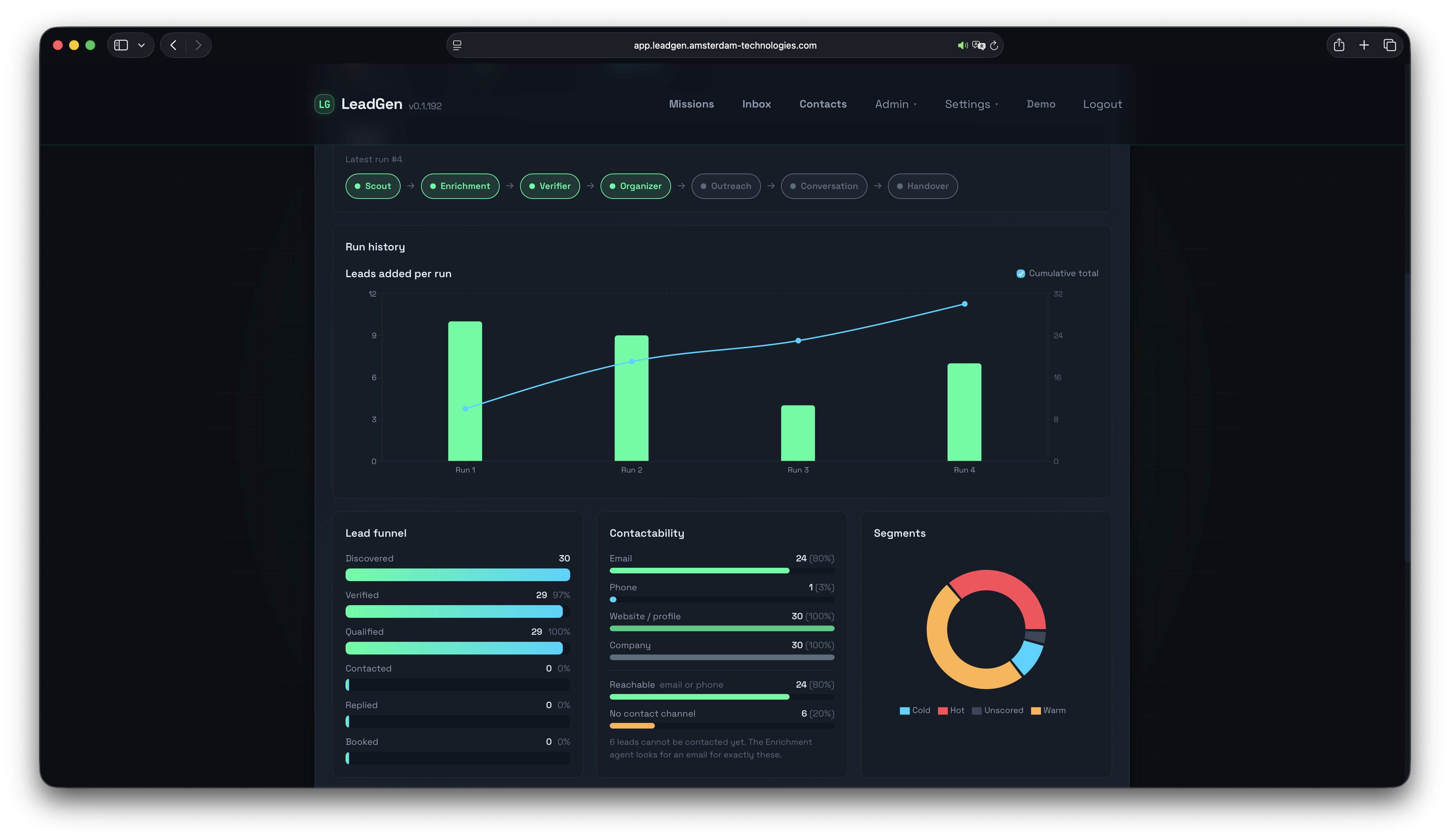
The fundamental architectural insight of LeadGen is treating prospecting as a sequential reasoning problem. Rather than executing a single large prompt, LeadGen orchestrates six specialized AI agents that pass context down a continuous pipeline. The Scout discovers candidates, the Verifier corroborates the data, the Organizer scores fit, the Outreach agent personalizes communication, the Conversation agent handles initial replies, and the Handover agent synthesizes the engagement for human intervention. By isolating these cognitive tasks, LeadGen achieves high precision, eliminates hallucinated data, and scales the logical deduction of a senior sales development representative across thousands of prospects simultaneously.
Key Capabilities
Multi-Platform Discovery and Intelligence (Scout & Enrich)
The Scout agent bypasses static databases by dynamically executing targeted searches across the open web and proprietary platforms (LinkedIn, GitHub, X, Facebook, Instagram, SoundCloud, Resident Advisor). Grounded by Google Web Search and equipped with model-facing tools, the agent navigates directories and listings autonomously.
- Keyless Open Data Mining: LeadGen integrates native function tools for OpenStreetMap (OSM) via Overpass QL, the Global LEI Foundation (GLEIF), and SEC EDGAR. This allows the Scout to build robust lead profiles for local businesses, EU/UK companies, and US public entities without requiring external API subscriptions.
- Dynamic Asset Processing: Users can upload reference documents and images. A built-in Tesseract Optical Character Recognition (OCR) pipeline extracts text, emails, and URLs, utilizing SHA-256 deduplication to cache results efficiently.
- Headless URL Prefetching: The Scout agent utilizes headless Chrome (chromedp/CDP) to render JavaScript-heavy sites, allowing the model to navigate "Our Team" pages and complex corporate directories that defeat standard HTML parsers.
Intelligent Verification & Scoring (Verifier & Organizer)
Data quality is enforced by the Verifier and Organizer agents, which act as a rigorous quality assurance layer before any communication is dispatched.
- Anti-Hallucination Engine: The Verifier agent cross-references all Scout-discovered data against live Google Search results. It generates a deterministic audit trail (
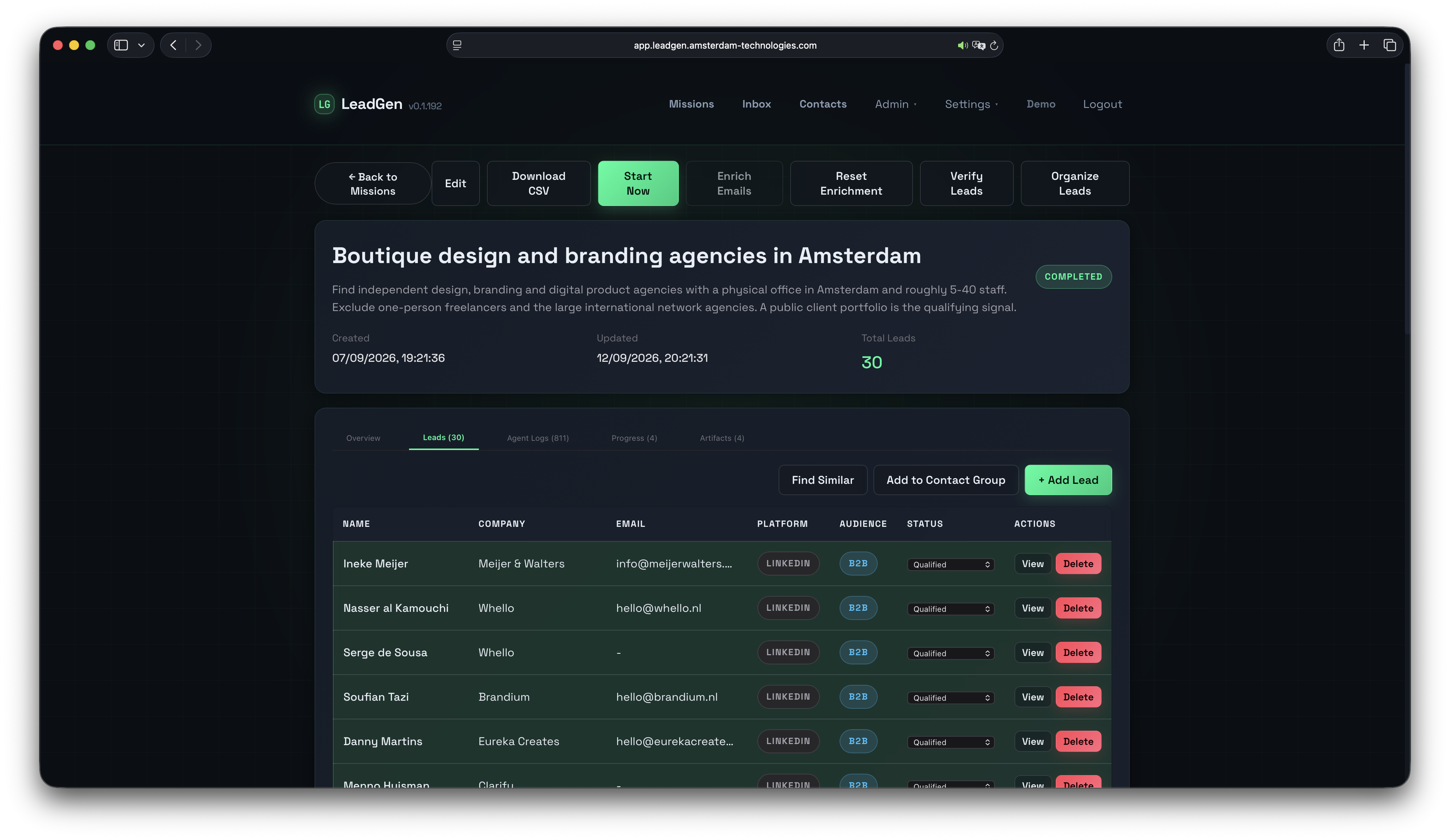
verification_steps), detects hallucinated profiles, corrects malformed URLs, and drops invalid candidates. - Automated Segmentation: The Organizer agent evaluates corroborated profiles against the mission's targeting criteria, assigning a 0-100 fit score and classifying leads into HOT, WARM, COLD, or UNQUALIFIED tiers. It automatically categorizes the audience type (B2B vs. B2C) to route leads through appropriate compliance gates.
- "Find Similar" Clone Modeling: LeadGen analyzes the traits of previously successful leads (those who replied or booked a meeting) to discover lookalike prospects across internal databases, OSM, and the web, eliminating the need for manual boolean filter construction.
Omnichannel Outreach & Compliance
The Outreach agent translates high-scoring profiles into highly personalized, channel-specific communications while strictly adhering to deliverability best practices.
- Multi-Channel Execution: LeadGen supports native SMTP for email, Twilio for SMS, and specialized integrations for WhatsApp, LinkedIn, and Instagram Direct Messages.
- Deliverability and Anti-Spam: Email payloads are generated with RFC 2369/8058 List-Unsubscribe headers, RFC 2047 encoding, and custom Message-ID generation. Threading is preserved via
In-Reply-ToandReferencesheaders, ensuring follow-ups land naturally in the prospect's inbox. - Strict Compliance Controls: Do-not-contact suppression registries are strictly scoped per-organization. Automated unsubscribe links are secured via HMAC verification, and GDPR Right-to-Erasure functions completely scrub subject data from all mission logs and queues.
Autonomous Response Handling
Once contact is made, the platform's background pollers monitor inboxes (IMAP, WhatsApp, etc.) and route inbound messages to the Conversation agent.
- Intent Classification: The Conversation agent parses replies to classify intent (interested, question, not interested, out of office, complex/human needed).
- Contextual Auto-Replies: For routine inquiries, the agent drafts and dispatches immediate, context-aware responses.
- Smart Handover: When a prospect demonstrates high intent or requests a meeting, the Handover agent (powered by Gemini Pro) generates a comprehensive briefing package. This includes an executive summary, BANT (Budget, Authority, Need, Timeline) qualification signals, and strategic talking points, delivering a fully briefed opportunity to the human sales team.
Architecture & Technical Design
LeadGen is engineered as a high-throughput, multi-tenant SaaS application. The backend is written in Go 1.25, leveraging its robust concurrency primitives, while the frontend is delivered via Next.js 15 and React 19. State and configuration are managed in a deeply indexed MongoDB 7.0 cluster.
Agent Orchestration: The core pipeline relies on the Google Agent Development Kit (ADK) v1.4.0. Rather than executing a monolithic prompt, LeadGen uses a sequential state machine (orchestrator.go). The shared missionqueue caps concurrent executions to maintain strict API limits and system stability. A cancelation context (context.WithCancel) is propagated through the entire pipeline, ensuring that halted missions immediately release resources without losing incrementally saved lead batches.
Tenancy and Data Isolation: Architecture strictly enforces per-organization data tenancy. Configuration variables (such as SMTP credentials, integration tokens, and compliance identities) are strictly scoped to the tenant's org_id. LLM context windows are isolated, and background workers (such as the IMAP and Instagram pollers) resolve the canonical organization for every inbound message before dispatching the Conversation agent. This guarantees that one tenant's proprietary prospecting data never influences another's pipeline.
Extensibility via Model Context Protocol (MCP): LeadGen exposes a native MCP server (/api/mcp), bridging the gap between the platform and external AI assistants (like Claude Code or Cursor). This allows technical operators to interact with missions, inspect lead schemas, and trigger outreach via standard conversational interfaces, bounded by strict OAuth 2.1 access tokens and scope enforcement.
Use Cases & Scenarios
B2B SaaS Go-To-Market
- Context: A newly funded developer tools startup needs to acquire its first 100 enterprise beta testers but lacks a dedicated sales team.
- Application: The founder defines a mission targeting "Director of Engineering" and "DevOps Lead". The Scout agent utilizes the
github_searchtool to identify engineers contributing to relevant open-source repositories, extracting contactable addresses from public commits. The Organizer scores the leads based on repository relevance, and the Outreach agent sends highly technical, personalized invitations. - Outcome: The startup generates high-quality technical leads automatically, bypassing expensive and outdated B2B contact databases.
Boutique Recruitment Agency
- Context: A specialized recruiting firm needs to identify hiring managers at local logistics companies in a specific geographic region.
- Application: The firm configures a mission focused on a defined city. The Scout agent leverages the keyless OpenStreetMap (
osm_search) and GLEIF integration to identify physical logistics depots and their corporate registries. The Verifier agent cross-references these entities on Google Search to find current HR Directors. - Outcome: The agency builds a hyper-local, highly accurate contact list without paying per-lead extraction fees to incumbent data brokers.
Event Sponsorship Acquisition
- Context: A conference organizer needs to find sponsors for an upcoming electronic music technology summit.
- Application: The organizer uploads a PDF sponsor packet from a competing event. LeadGen's OCR pipeline extracts all company names and URLs. The Scout agent treats these as seeds, utilizing the "Find Similar" feature to identify companies with identical market positioning across the web and LinkedIn. The Conversation agent handles preliminary budget inquiries via email.
- Outcome: The organizer scales their sponsorship outreach exponentially, with human reps only stepping in once a prospect asks for the booking link.
Technical Hardware Sales
- Context: A hardware vendor sells specialized networking equipment to internet service providers (ISPs).
- Application: The sales team creates a recurring cron-based mission targeting specific technical certifications and job titles on X (formerly Twitter) and LinkedIn. The Handover agent is configured to aggressively filter out unqualified responses.
- Outcome: The platform runs autonomously every Monday morning, processing hundreds of profiles and delivering a concise list of 5-10 highly qualified, BANT-analyzed handover packages directly to the sales team's CRM.
Pricing & Plans
LeadGen is delivered as a fully hosted, cloud-native SaaS platform. Standard tiers run on Amsterdam Technologies' multi-tenant cloud infrastructure, while Enterprise plans offer dedicated instances and custom integrations.
| Plan | Price | Included Features |
|---|---|---|
| Pro Monthly | €59/month | 5 AI Agents, Unlimited Missions, Multi-platform Prospecting, Automated Outreach, Lead Scoring, Scheduled Campaigns, Priority Support |
| Pro Yearly | €590/year | All Pro features (Save €118 annually) |
| Enterprise | Custom | Unlimited usage, dedicated instance, SSO/SAML, SLA guarantee, on-premise option, custom integrations, dedicated account manager |
All standard plans are cloud-hosted. Self-hosting options and dedicated infrastructure are exclusively available under the Enterprise tier.
Frequently Asked Questions
How does LeadGen ensure data accuracy and prevent AI hallucinations? LeadGen mitigates hallucinations by separating discovery and verification into distinct cognitive phases. Every lead discovered by the Scout agent is passed to an independent Verifier agent, which executes real-time Google Search queries to corroborate employment, URLs, and contact details. Unverifiable data is automatically discarded before the scoring phase.
Are my proprietary lead lists and API keys secure? Yes. LeadGen implements a strict per-organization tenancy architecture. All databases, suppression lists, and configuration settings (including SMTP credentials and API tokens) are hard-scoped to your unique organization ID. Data from your successful conversions is never used to train generalized models or improve discovery for other tenants.
How does the system handle email compliance and GDPR? Compliance is treated as a foundational requirement. The platform will block commercial outreach if an organization does not configure a valid physical address and legal identity. LeadGen automatically injects HMAC-secured unsubscribe links and RFC-compliant List-Unsubscribe headers. Furthermore, built-in GDPR Right-to-Erasure endpoints allow administrators to completely purge a prospect's data across all databases and logs.
Can I run LeadGen on my own infrastructure? By default, LeadGen is a fully hosted SaaS platform designed for immediate deployment without infrastructure overhead. For organizations with strict data residency or air-gapped requirements, self-hosted and dedicated on-premise deployments are available exclusively via our Enterprise tier.
Why Amsterdam Technologies
Amsterdam Technologies engineers solutions that replace manual repetition with autonomous intelligence. Headquartered in Amsterdam, our engineering-first culture prioritizes architectural resilience, strict data privacy, and deterministic system behavior over superficial AI wrappers. LeadGen exemplifies this philosophy: it is not a chat interface slapped onto a database, but a highly concurrent, mathematically rigorous multi-agent system designed to execute complex business logic at scale. By combining deep integrations with modern Go and Next.js architectures, we deliver tools that fundamentally alter operational economics.
- Website: https://leadgen.amsterdam-technologies.com
- Contact: support@amsterdam-technologies.com
- Company: amsterdam-technologies.com
Product screenshots